A few days ago, a parent shared a concern with me that I know is weighing on many families: “Shubhangi, I saw the interview with the CEO of Anthropic. He predicts that by 2026, AI will be able to do most coding on its own. If the technology is going to build the applications itself, is learning to code still the right path for my child?”
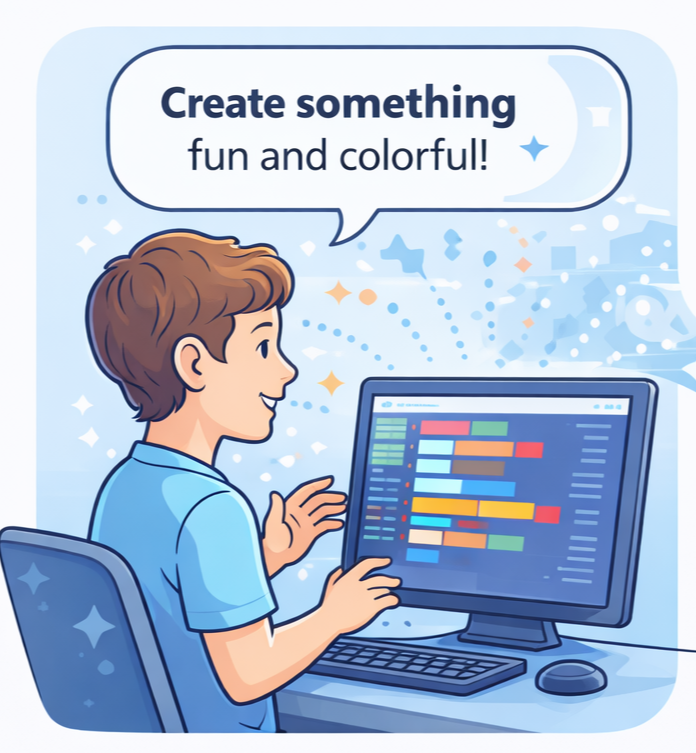
This is a landmark moment in education. We are moving into the era of “Vibecoding.” For those who haven’t heard the term, it is essentially the ability to build software just by "talking" to a computer, describing a vibe or an idea and letting the AI generate the result.
It is a massive leap in accessibility, but it raises an important question for parents and schools: In a world where everyone has a "magic wand," what is the actual skill that will set a child apart?
The Lesson from the Calculator
To understand this, we only need to look at the history of Mathematics. When the electronic calculator was first introduced, there was a widespread fear that the subject would become obsolete.
However, we didn’t stop teaching math. We realized that while the calculator could perform the calculation, it could not perform the logic. A student who doesn’t understand the concepts of multiplication might get a number from a screen, but they will have no idea if that number is physically possible or logically sound. They are essentially at the mercy of the machine.
In the AI era, coding is the "Mental Math" of the digital age. AI can generate a thousand lines of code in seconds, but it often creates a "Black Box," a result where the user doesn't really know how the gears are turning inside. If a child doesn't understand the logic inside that box, they are just a user. In a competitive professional world, users are easily replaced; the architects who understand the systems are not.
The Architect vs The User
AI is predictive, not logical. It "hallucinates." It creates code that looks perfect on the surface but may contain hidden security flaws or logical errors that only appear when the system is under pressure.
If a student only knows how to "vibe" with an AI, they are stuck the moment the machine makes a mistake. They have no choice but to keep asking the AI to "try again" and hope for a better result.
However, a child with a Programming Mindset acts as the Auditor. When an AI-generated system fails or leaks data, the student with foundational logic is the only one who can open that "Black Box," find the error, and fix the engine. In the professional world of 2026 and beyond, companies won't just be looking for people who can "prompt" an AI; they will be looking for the experts who can verify, secure, and lead what the AI produces.
Developing the Skill of Decision-Making
At Pure Minds, we recognize that the goal of coding education has shifted. It is no longer about memorizing lines of syntax; it is about developing the ability to make informed technical decisions. Our NCFE courses develop the skills required to think logically and make these decisions. This framework moves the focus away from the "language" and toward the "architecture" of a solution.
- In our Primary levels (6-10): We use Scratch to teach the "Physics of Logic," the law of cause and effect in a digital environment.
- In our Senior levels (10-17): Whether it is Python or AI/ML, the objective is to build a "Full-Stack Mindset." This is the ability to design a system from the ground up, ensuring the student is always the Pilot in command, and the AI is merely the high-powered engine.
Your Answer to the AI Question
If you have been on the fence about the coding pathway due to the rapid advancement of AI, let this be your answer:
AI has made the barrier to entry lower, but it has made the cost of a mistake much higher. The faster AI advances, the more the world will need humans who actually understand how the gears turn. Without the foundation of logic, a child is a passenger in an AI-driven world. With it, they are the Architect.
I encourage you to enroll your child in our NCFE-aligned pathways today. Let’s stop preparing them to be passengers in an AI-driven world and start training them to be the Pilots.
Don’t let them just use the future. Let’s teach them to architect it.

.png?width=100&height=55&name=Untitled-1%20(1).png "Untitled-1 (1)")