
.png?width=100&height=55&name=Untitled-1%20(1).png "Untitled-1 (1)")
Last updated: 11 August 2026
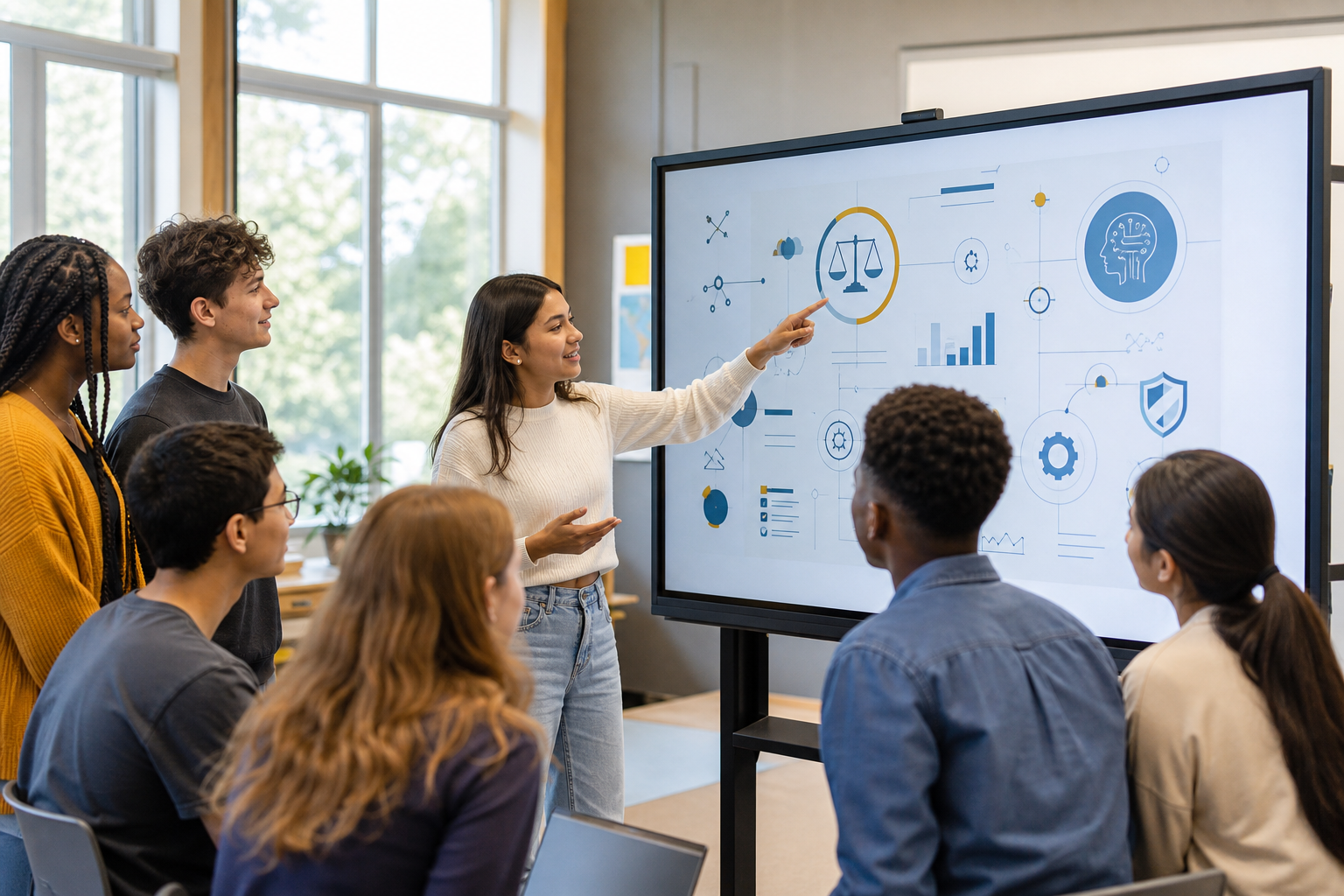
Schools searching for guidance on AI policies now face a practical challenge: how do you allow useful AI in education without weakening thinking, privacy, academic integrity or trust? The proposed STUDENTS FIRST Act offers a helpful framework because it balances AI literacy, teacher judgment, student accountability and parental visibility. What makes it especially notable is that it originated in the United States through a student-led process, with teenagers themselves debating what responsible AI use in schools should look like. For educators, school leaders and families in the UAE and beyond, the value of this story is not only what is happening in the US. It is what other school districts and educational authorities around the world can learn from it.
Artificial intelligence is now part of education whether schools feel ready or not. Students are already using AI to brainstorm, summarise, research, revise and sometimes bypass the hard work of learning. Teachers are using it to plan lessons, create practice materials and save time on repetitive admin. Parents are trying to work out where support ends and shortcutting begins.
That is why the recent NPR report on the student-led STUDENTS FIRST Act matters. In the article, high school students from across the United States gathered to debate and draft their own policy framework for AI in schools. That origin matters. It means the proposal did not come only from policymakers, vendors or school administrators. It came from the group living closest to the daily reality of AI in education: students themselves. Their conclusion was not anti-AI and it was not blindly pro-AI either. It was more mature than that. Their message was that AI belongs in education only when it strengthens learning rather than replacing it.
The angle for this article is simple. We are not looking at the STUDENTS FIRST Act only as a US education story. We are looking at it as a live policy case study. What can school districts, regulators, curriculum leaders and educational authorities in other countries take from this debate? Which ideas travel well across systems? Which principles are worth adapting locally? And what does responsible AI policy in schools need to include before poor habits become normal?
For Pure Minds Academy, this is an important moment. We have been saying for some time that children should not simply be handed AI tools and told to get on with it. They need AI literacy, critical thinking, ethical guardrails and practical guidance. The future will not belong to children who avoid AI completely. It will belong to children who know when to use it, how to question it and when to think for themselves.
The STUDENTS FIRST Act matters because it shifts the AI-in-education conversation away from panic and toward structure. According to NPR's reporting, the student senators proposed rules covering student use, teacher responsibilities, parent rights, privacy, plagiarism, AI literacy and school accountability.
At its core, the bill tries to answer a difficult question: **how do you let students learn with AI without allowing AI to do the learning for them?**
That question is not only relevant in the United States. It matters in every school system now. The debate is already live in Dubai, the UAE and globally because classrooms are facing the same pressures:
The students behind the bill recognised something many adults still resist. AI is not going away. So the answer cannot be denial. It has to be literacy, policy and judgment.
The proposed act is extensive, but several principles stand out.
The bill argues that schools should teach AI literacy as soon as students start using digital devices in class. That literacy should include misinformation, plagiarism, bias, privacy, appropriate academic use, environmental impact and an understanding of how AI works.
This is one of the strongest ideas in the proposal. AI literacy should not start after misuse becomes a problem. It should begin before habits form.
One of the most debated provisions is that students should never use AI for the act of writing itself, though older students may use it for editing, brainstorming and studying. This is an attempt to protect original thought, written expression and genuine mastery.
Not everyone will agree with the exact line, but the principle is sound. Writing is not just a way to present knowledge. It is one of the ways children develop it.
If a student uses AI, the bill says they must disclose how and where it was used. If AI is used without permission or without citation, it can be treated as plagiarism.
That matters because hidden AI use is where trust breaks down fastest.
The proposed framework allows teachers to ask for oral defences, handwritten work or in-person discussion if AI was used during the drafting phase. That is a sensible response to a new problem. If a student can explain, defend and apply their thinking, learning is more likely to be real.
The act also includes rules around student data collection and bans the use of AI to profile students by ethnicity, religion, appearance, beliefs or values. That is not a minor detail. In education, AI policy is not only about cheating. It is also about rights, power and data.
Parents should take three big lessons from the proposed policy.
The bill suggests that parents should encourage balanced technology habits, ethical behaviour and critical thinking. That is right. At home, children often use AI in less supervised ways than they do at school. Without boundaries, the line between support and substitution disappears quickly.
One of the smartest parts of the proposal is that it expects parents to learn enough about AI to guide their children. That does not mean every parent needs to become a technical expert. It means they need to understand the difference between healthy academic support and intellectual outsourcing.
A child asking AI to quiz them on a science topic is one thing. A child pasting an assignment brief into a tool and submitting the result as their own is something else entirely.
The act says families should be told how AI is being used in school and should have the right to ask questions. That is essential. The more AI enters education, the more trust depends on clear communication between schools and families.
The proposed act is a reminder that AI policy cannot be reduced to one sentence in a handbook.
Telling students to "use AI responsibly" is not enough. Schools need to define:
One of the most sensible aspects of the bill is that it protects teacher judgment. AI should not replace the educator-student relationship where human connection is essential. Nor should teachers be punished for choosing not to use AI if they are otherwise meeting curriculum goals.
That matters because good education is relational. AI can support that work, but it cannot replace trust, care, motivation or classroom intuition.
The proposal also recognises the limits of AI detectors by requiring human review when misuse is suspected. That is important because AI detection tools can produce false positives. Schools that rely too heavily on automated accusation risk punishing honest students and damaging confidence.
A useful AI policy for schools should do more than ban obvious misuse. It should define acceptable use, teacher permissions, disclosure rules, privacy boundaries, consequences for misconduct, age-appropriate literacy and methods for verifying genuine student understanding. The best school AI policies are clear enough for students to follow, practical enough for teachers to enforce and flexible enough to adapt as the technology changes.
A strong school policy should include:
Although the bill is American and student-led, its relevance is global. The UAE is already taking AI seriously at a national level. That creates huge opportunity, but also responsibility.
For students in the UAE, the question is not whether AI will be part of their future. It already is. The better question is what kind of learners they will become in an AI-rich world.
They need to be able to:
This is exactly where a future-focused education provider has work to do.
The right balance is not zero AI and it is not unlimited AI. It is guided use.
At Pure Minds Academy, we believe children should learn three things in parallel.
Children should understand what AI is, how it generates outputs, where it can be useful and where it can mislead.
They must know that using AI without permission, without attribution or in ways that bypass effort damages learning. They also need to understand privacy, bias and digital responsibility.
They should learn how to use AI to explore ideas, test knowledge, improve questions, build prototypes and think more creatively without surrendering independent reasoning.
That is very different from treating AI like an answer vending machine.
There are four common mistakes.
Both extremes are unhelpful. AI is a tool. Powerful, imperfect and increasingly unavoidable.
Academic integrity matters, but that is not the whole issue. AI policy also needs to address privacy, bias, emotional dependency, data security and unequal access.
Children may be comfortable with technology, but comfort is not the same as judgment.
By the time adults decide students are "old enough" to learn about AI, many have already formed habits around it. Early guided exposure is usually safer than late reactive control.
A sensible AI policy for children should include five layers.
Teach children what AI is, how it works and what its risks are.
Make clear when AI is allowed and when it is not.
Require students to disclose AI use in a simple understandable way.
Ask students to prove understanding through discussion, reflection or practical application.
Keep educators and parents central to the process, especially where judgment, wellbeing and ethics are involved.
Pure Minds Academy exists to prepare children for the world they are growing into, not the one adults are nostalgic for. AI is now part of that world.
But preparation is not the same as blind adoption. The goal is not to teach children to depend on AI. The goal is to help them use it intelligently, ethically and confidently.
That means teaching:
For parents, this is no longer optional enrichment. It is part of modern digital education.
For schools, it is becoming part of responsible policy.
For children, it may become one of the defining skill gaps of the next decade: not access to AI, but judgment in using it.
The most interesting part of the NPR story is not just that students drafted a serious AI policy. It is that many of them understood the real risk better than adults do. Their concern was not simply that AI exists. Their concern was that children might stop thinking if adults fail to teach them how to use it well.
That is the right concern.
The future of education will not be protected by banning every tool. It will be protected by teaching children how to think, question, verify and act responsibly in a world full of powerful systems.
That is the conversation schools need now. It is also the work families need help with now.
And it is exactly why AI literacy, ethical use and future-ready learning should be taken seriously long before bad habits become normal.
The STUDENTS FIRST Act is a student-led US policy proposal focused on AI use in K-12 schools. It covers student rights, teacher responsibilities, parent visibility, privacy, AI literacy and academic integrity.
AI policy matters because students are already using these tools. Without clear rules, schools risk confusion around plagiarism, privacy, overreliance, bias and unequal access.
Children can benefit from AI when it is used for guided support such as brainstorming, studying, questioning and feedback. It becomes harmful when it replaces thinking, writing or genuine understanding.
Parents should teach children that AI can be useful but not always accurate, that privacy matters, that school rules matter and that using AI should never replace original effort or honest learning.
Schools can introduce AI responsibly by teaching AI literacy early, setting clear usage rules, requiring transparency, protecting student data and keeping teachers at the centre of judgment and assessment. A strong AI policy for schools should make those expectations visible in day-to-day teaching rather than burying them in a one-page handbook note.
What do you think? Share below: