
.png?width=100&height=55&name=Untitled-1%20(1).png "Untitled-1 (1)")
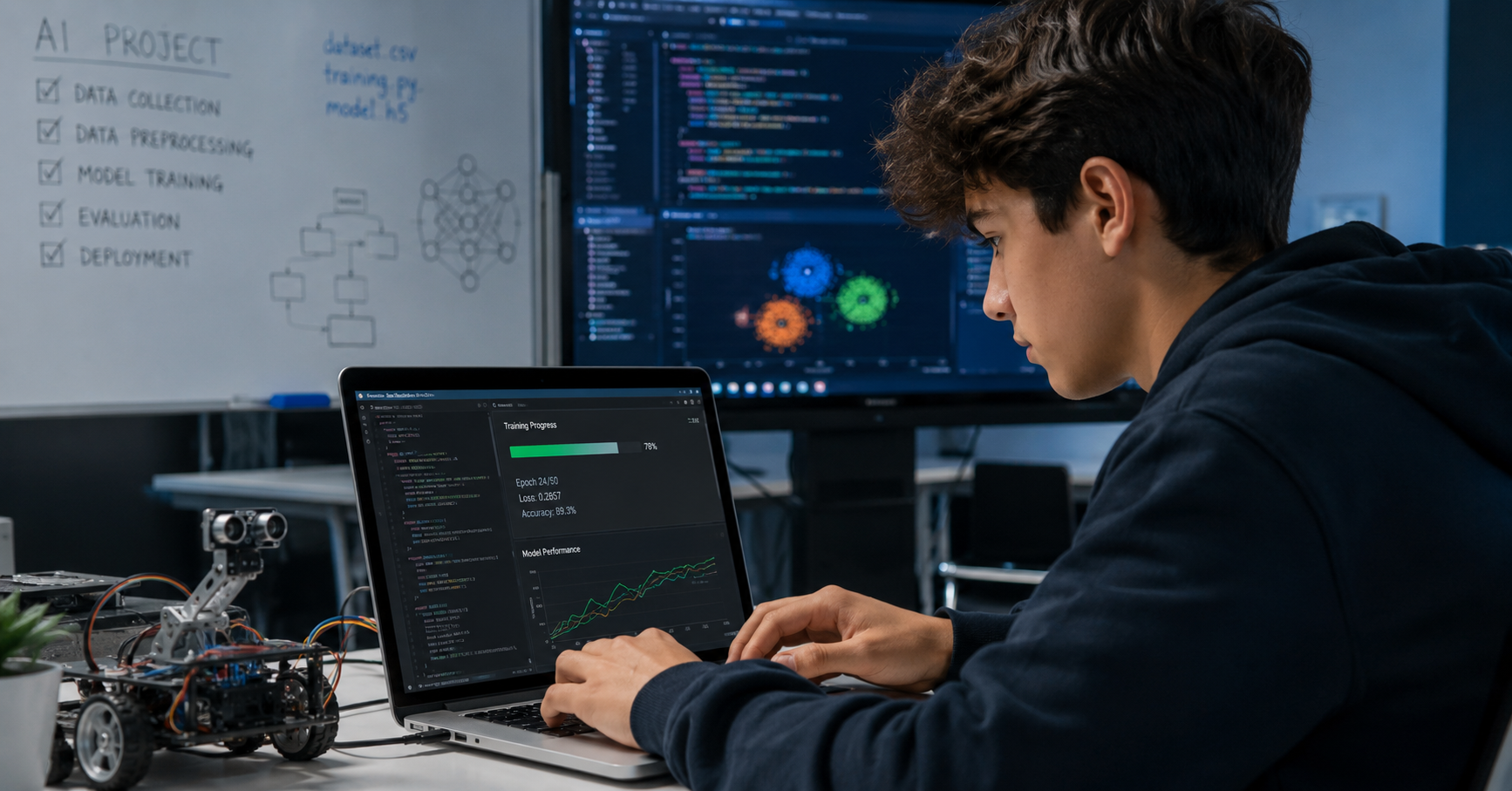
A serious AI bootcamp gives students more than excitement. See what Pure Minds Academy students actually build and learn in Dubai.
📌 Quick Summary
A serious AI bootcamp gives students evidence of understanding, not just excitement that fades after the week ends.
Every student who walks into our AI Bootcamp has already used ChatGPT. That is not where we start. That is where we begin asking the next question.
Students leave the bootcamp with more than excitement. They leave with evidence of understanding, project experience and progress they can explain. That combination is rarer than it sounds in AI education for young people.
Excitement matters. But excitement backed by nothing real fades quickly. Students should be able to explain what they built, describe what they learned and talk through the process that got them there. If the only thing a student can say after a camp is that it was really cool, the camp has not done enough.
A serious AI summer camp should give students practical exposure to how AI sees, learns, decides and acts, and connect those ideas to real outputs: models, automations, apps, interfaces and decision workflows.
Pure Minds Academy's AI Bootcamp has been built as an intensive, hands-on pathway for students who are ready to do more than watch demos.
Students work with industry-relevant tools and platforms across three weeks. They explore model training, autonomous workflows, Python, APIs, webhooks and web app deployment.
What makes this valuable is the context alongside it. Students today know that AI is helpful. What most of them do not understand is how AI is actually being used in professional settings: how products are built with it, how workflows are automated, how decisions get made inside systems they interact with every day. The bootcamp gives them that picture.
The bootcamp is built around doing, not watching. Students are taken through the process step by step, shown what is possible, shown where the challenges are, and supported at every stage rather than left to figure things out alone.
Children engage with the material differently when someone is in the room working through it alongside them, responding to what they are finding difficult and showing them what comes next. By the end of the week, most students have surprised themselves with what they can do. That is not something that happens by accident. It is the result of how the programme is structured.
Building is what turns curiosity into capability. Students build tangible outputs that help them understand both the power and the limits of AI.
Programme highlights include:
That combination is unusual in children's education. It gives students a much clearer picture of how AI systems are assembled, tested and applied.
Tools change quickly. Underlying thinking does not. If students only chase the newest AI interface, they learn dependency. If they understand how systems behave, they gain something that transfers.
This is something I have come to believe through years of teaching STEM and AI. A student who understands models, logic, testing and responsible use will adapt as tools evolve. That matters far more than short-term familiarity with one product. Novelty is not the goal. Understanding is.
One of the things we focus on early is helping students make sense of the tools that exist. There is a lot of AI out there and most children have only ever touched a small part of it.
We take them through what different tools can do, what kinds of outputs they produce and how to make informed decisions about which tool fits which problem. That breadth matters. A student who understands the landscape is in a much stronger position than one who has only ever learned to use one platform well.
Alongside that broader understanding, students work on real technical projects. The bootcamp covers AI robotics, Python and machine learning, and AI with microcontrollers. These are not simplified versions of real skills. They are the real thing, taught at the right pace for the age group.
When a student has trained a model, programmed a robot or connected AI to hardware, they have a different relationship with the technology. They know it is buildable. They know they can build it.
Bootcamps are better for immersion and momentum. Weekly classes are better for steady reinforcement. The best choice depends on what stage the student is at.
| Format | Best for | Main advantage |
|---|---|---|
| AI bootcamp | Fast progress in a short period | High momentum and visible outputs |
| Saturday classes | Steady long-term development | Consistent reinforcement and skill building |
Many families use the bootcamp as the starting point, then continue through term-based programmes or the wider School of AI journey.
Ask what students will build, what concepts they will understand and how responsible use is taught. If those answers are vague, the programme may be more promotional than educational.
Also ask whether the camp groups students properly by age and level. A meaningful AI experience for a teenager should not look the same as a general activity with an AI label placed on top. Good programmes are designed with progression in mind.
Students do not need another summer that passes without leaving them with anything real. They need an experience that builds genuine confidence, the kind that comes from working through something hard with the right guidance and discovering they are more capable than they thought.
The question worth asking at the end of the bootcamp is not "did my child try AI this summer" but "did my child build something with AI and understand how it works." That is the shift the bootcamp is designed to create. Not just excitement. Excitement with evidence.
If this topic is relevant to your child, these pages are the best next stops on the Pure Minds Academy website:
1. What is the difference between an AI bootcamp and a standard summer camp?
An AI bootcamp is more intensive, more project-led and more focused on practical outputs such as models, automations, apps and working code.
2. Who should join an AI summer bootcamp?
AI bootcamps are best for students who are curious about technology, want faster momentum and are ready for deeper project work in a short period.
3. Do students need prior coding experience?
No, they don’t. We assess the age and level of each student and build from the right starting point, always aiming for visible outputs by the end.